

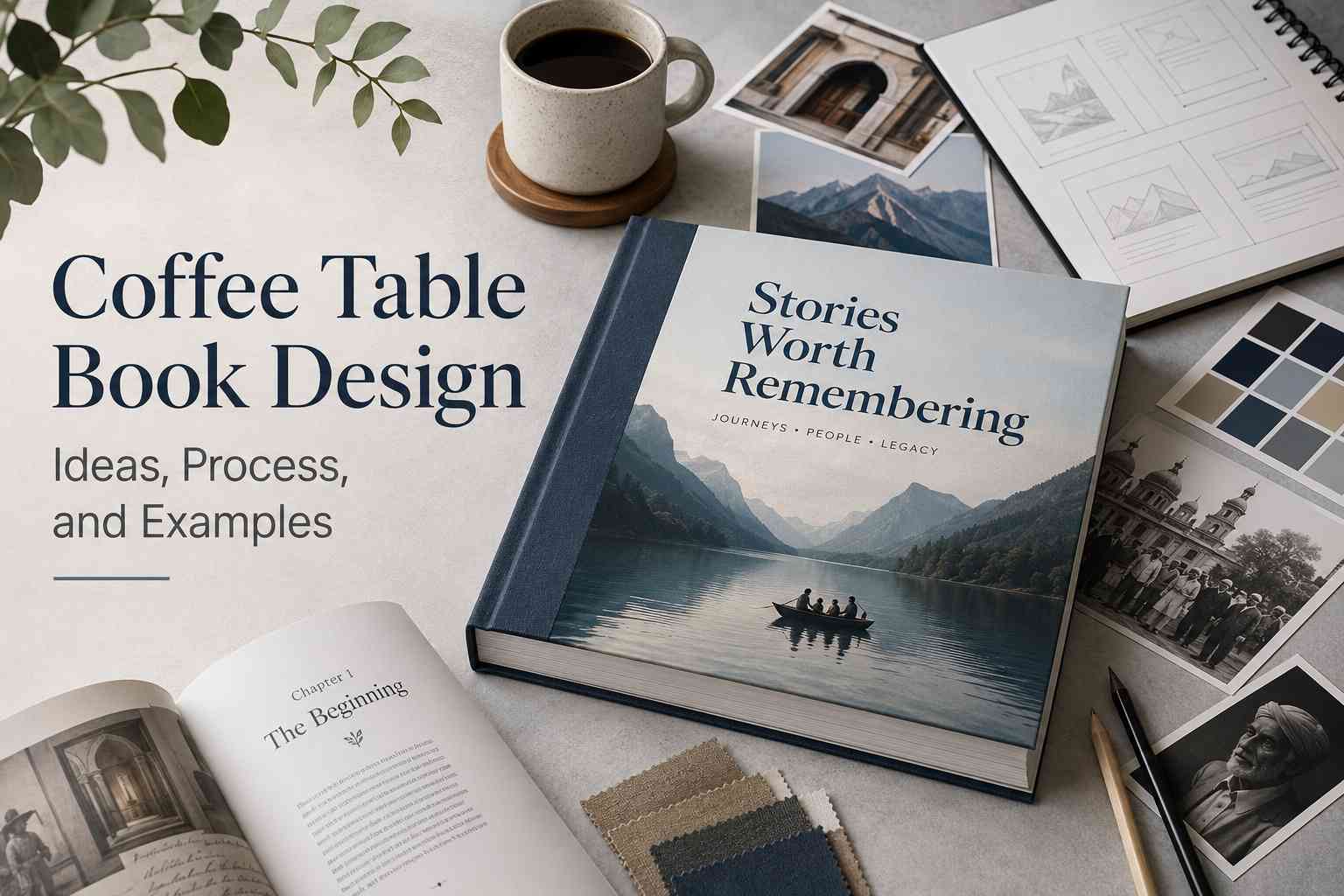
A beautiful coffee table books is more than a collection of photographs. It is a curated visual experience that invites readers to pause, explore, and return again. Whether it celebrates a family legacy, a business journey, an institution, a destination, or a milestone, its success depends on how effectively the story is transformed into a memorable visual form.
At Maneesh Media, we believe every meaningful journey deserves thoughtful presentation. Strong coffee table book design combines storytelling, photography, typography, sequencing, color, and production quality into one cohesive object. The result should not feel like a catalogue or an oversized album. It should feel personal, premium, and timeless.
This guide by Life Katha explores useful ideas, the complete process, and practical examples to show how an exceptional book comes together.
What Makes a Coffee Table Book Special?
Coffee table books are designed to be seen as much as read. They usually feature large pages, striking visuals, spacious layouts, and carefully edited text. Readers may open the book anywhere, discover a photograph, read a short story, and still understand its emotional context.
That freedom makes coffee table book design both exciting and demanding. Every spread must work individually, while the full book follows a clear journey. The best examples balance beauty, clarity, and emotion, becoming objects people proudly display and preserve.
Popular Coffee Table Book Ideas
A book becomes more powerful when it has a specific point of view.
Family Legacy Books
A family legacy book can bring together ancestral photographs, letters, family trees, achievements, traditions, and memories. Chapters may explore roots, values, migration, enterprise, celebrations, and the next generation rather than simply arranging everything by date.
Business and Institutional Books
Companies, schools, hospitals, associations, and trusts often create books for anniversaries, founder stories, or milestones. The strongest examples combine archives, interviews, community stories, and social impact without sounding like brochures.
Travel and Cultural Books
A destination book can explore architecture, landscapes, food, crafts, festivals, and local voices. A creative coffee table book design may use maps, full-bleed images, illustrated details, travel notes, and short essays to create a sense of place.
Personal Achievement Books
Entrepreneurs, doctors, artists, philanthropists, and community leaders can document their journey through a personal portrait book. These books work best when they reveal not only success, but also struggle, relationships, beliefs, failures, and lessons.
The Complete Coffee Table Book Design Process
Creating a premium book requires more than selecting attractive photographs. The process moves through research, storytelling, design, editing, and production.
1. Define the Purpose and Audience
Before writing or designing, clarify why the book is being created. Is it meant to preserve a family story, celebrate an anniversary, present a founder’s journey, strengthen an institution’s identity, or serve as a premium gift?
The audience matters too. A book for family members will have a different tone from one created for clients, alumni, donors, or the public. A clear purpose helps determine what to include, what to leave out, and how emotional or formal the book should feel.
2. Build the Story Structure
A good book needs a narrative spine. Chronology is one option, but the story can also be divided by themes, locations, people, achievements, or defining moments.
A founder’s book might cover early influences, struggle, the breakthrough, leadership philosophy, family, social contribution, and future legacy. This structure guides research, interviews, image selection, and writing.
3. Collect and Organize Content
Content may come from albums, company archives, clippings, certificates, letters, diaries, speeches, interviews, and digital files. Old images may need restoration, while dates and names may require verification.
Organize the material by chapter and maintain a tracker for captions, dates, sources, and permissions. When the subject has a rich story but limited written material, professional ghost writing services can turn interviews and notes into polished narratives while preserving the subject’s voice.
4. Write for a Visual Format
Text should support the visual experience, not overwhelm it. Use short chapter introductions, anecdotes, interview excerpts, captions, timelines, pull quotes, milestone notes, and feature stories.
The writing should be vivid and specific. Instead of saying, “The company faced many challenges,” describe one difficult decision, one uncertain year, or one moment that changed everything.
5. Establish the Visual Direction
Before designing pages, establish a color palette, typography, page size, grid, margins, image treatment, chapter-opening style, and caption system.
A heritage book may use warm neutrals, serif typefaces, and archival textures. A modern business book may use bold typography, clean grids, and restrained color accents. A cultural book may incorporate regional motifs. Even with varied content, the publication should feel like one complete experience.
6. Plan the Cover
The cover is the first emotional promise of the book. A strong coffee table book cover design should express the subject without revealing everything at once.
Possible approaches include a portrait, a symbolic archival image, minimal typography, an illustrated landmark, or a meaningful collage. The spine, back cover, endpapers, and slipcase should belong to the same visual system. Premium finishes should support the concept, not distract from it.
7. Design the Page Flow
Great coffee table book design is about rhythm. Readers need variation between visual intensity and quiet space.
A sequence might move from a full-page photograph to a short story, archival collage, quote, timeline, and minimal transition spread. This prevents repetition. Not every page needs to be filled; white space adds elegance and lets important photographs breathe.
8. Edit and Review Carefully
These books often contain names, dates, relationships, historical facts, and sensitive details. Review the manuscript and layouts for factual accuracy, grammar, image quality, captions, visual consistency, page numbering, permissions, and credits.
Separating content review from design review is helpful. A page can look beautiful and still contain an error, while correct information may need better visual treatment.
9. Prepare for Printing
Paper, binding, color reproduction, and finishing shape the final experience. Matte or silk-coated paper suits image-rich pages, while uncoated stock feels softer. Printed proofs should be checked for skin tones, dark photographs, and brand colors.
Good coffee table book design continues into production. A strong layout can lose impact if images print too dark, binding hides content near the spine, or the cover material does not match the intended look.
Examples of Effective Design Approaches
The Heritage Archive Approach
Ideal for families and institutions, this style combines restored photographs, handwritten letters, clippings, family trees, and short reflections. The design preserves the character of original documents while keeping pages clean and readable.
The Cinematic Biography Approach
A personal biography can unfold like a visual film. Chapter openings may use large portraits and short emotional lines. Major turning points can appear through dramatic spreads, while quieter sections use family photographs and reflective text.
The Modern Corporate Approach
A corporate book can combine statistics, architectural photography, employee portraits, timelines, and clean infographics. Rather than listing every achievement, it should highlight defining moments and explain why they mattered.
The Cultural Storytelling Approach
Books about communities, food, festivals, traditions, or crafts can combine documentary photography with oral histories and illustrated details. Colors and motifs may come from the subject but should be used with restraint.
How to Make the Book More Engaging
Engagement comes from discovery. Use gatefolds, tracing paper, inserts,
dividers, or archival pockets when the concept and budget allow. Add human voices through quotes, memories, and captions that reveal unseen details.
Most importantly, edit with discipline. Ten excellent photographs usually create more impact than thirty average ones.
Thoughtful coffee table book design or life story book also respects emotional pacing. After a major achievement, include a personal moment. After a dense historical section, create a quiet visual pause. This contrast makes the journey feel natural and memorable.
Maneesh Media helps individuals, families, organizations, and institutions transform meaningful journeys into beautifully designed books. Our process brings together research, interviews, writing, editing, visual storytelling, and premium production including biography writing services.
Each book begins with the subject’s identity, purpose, audience, and emotional core. From there, we shape a narrative and visual language that feels distinctive.
Whether the book celebrates a lifetime, an anniversary, family heritage, or an institutional legacy, the goal is not simply to record information. It is to create an experience future generations will value.
A well-made book can preserve voices, honour relationships, document achievements, and keep important memories from disappearing. That is the lasting power of coffee table book design.
FAQ’s
1. How long does it take to create a coffee table book?
The timeline depends on the amount of content, number of interviews, availability of photographs, design complexity, and review process. A professionally produced book may take several months because research, writing, image restoration, editing, design, proofing, and printing all require attention.
2. How many pages should a coffee table book have?
There is no fixed rule. Many premium books range from 100 to 250 pages, but the ideal length depends on the story. Quality and narrative flow matter more than reaching a particular page count.
3. What materials are needed to begin?
You can begin with photographs, documents, dates, names, milestones, and a basic idea of the story you want to preserve. Even when the material is unorganized, a professional team can help sort, verify, structure, and develop it into a complete publication.